


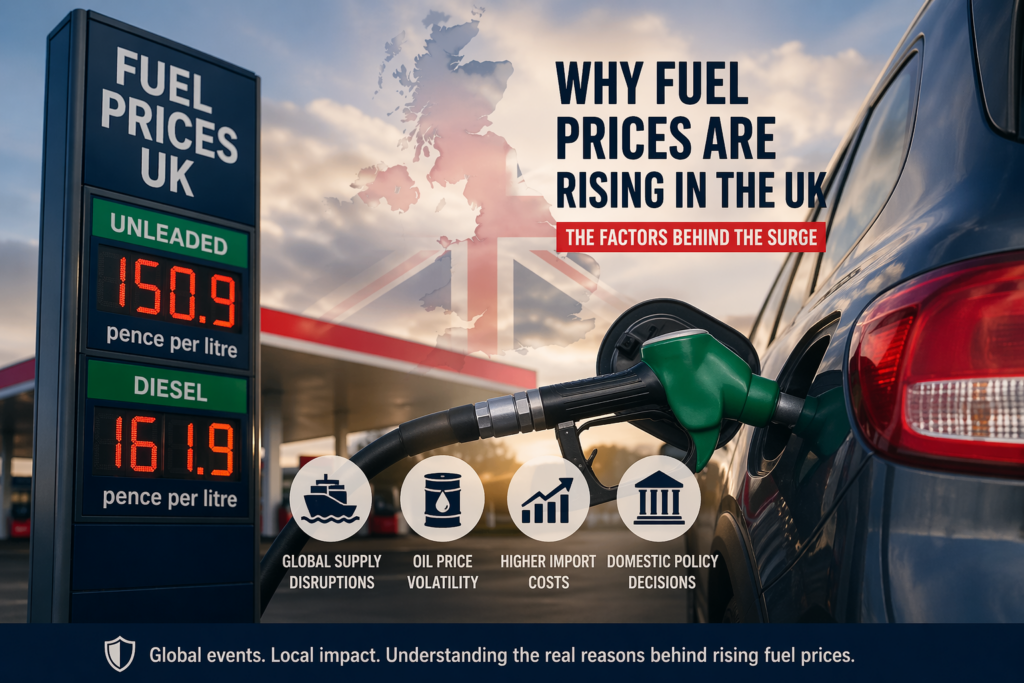

Fuel prices in the UK have climbed sharply in recent months, leaving drivers and businesses facing higher costs at the pump. While global events play a major role, the full picture is closer to home than many might expect.
A global shock, but not the whole story
The latest surge in petrol prices UK drivers are seeing has largely been linked to geopolitical tensions in the Middle East. The closure of the Strait of Hormuz, a key route for around 20 per cent of global oil and liquefied natural gas, has disrupted supply chains and pushed wholesale prices upwards.
Since the start of the Iran conflict, petrol prices have risen by around 25p per litre, while diesel prices UK motorists rely on have jumped by as much as 49p. That alone would be enough to strain household budgets.
But it is not the only factor at play.
The UK’s shifting fuel position
The UK was once in a relatively strong position. It has historically been a net exporter of petrol, producing more than it consumes. That advantage, however, has been gradually eroded.
A key change lies in bioethanol production. Standard petrol in the UK, known as E10, contains up to 10 per cent ethanol derived from plant-based sources. Until recently, a significant portion of this was produced domestically.
That changed following a trade agreement allowing tariff-free imports of up to 1.4 billion litres of ethanol from the United States each year. Domestic production has since declined sharply.
The result is a growing reliance on imports. Estimates suggest that around 4p per litre of recent petrol price increases can be attributed to higher shipping, insurance and war-related costs tied to importing ethanol.
Diesel and the wider economy
While petrol tends to grab headlines, diesel prices UK businesses depend on may have a wider economic impact.
Unlike petrol, the UK is now a net importer of diesel. This shift dates back to policy decisions in the early 2000s that encouraged diesel vehicle use, based on environmental assumptions at the time.
Since then, the country has become more exposed to global supply shocks. Before 2022, much of the UK’s diesel came from Russia. Following sanctions, supply has shifted towards the Middle East, increasing vulnerability to disruption in regions like the Strait of Hormuz.
When diesel prices rise, the effect spreads quickly. Transport, logistics, agriculture and public services all rely heavily on diesel. Increased costs are often passed through to consumers in the price of goods and services.
If your business services, repairs or modifies vehicles then Plan Insurance Brokers can source a tailored Motor Trade insurance policy for you. If you have any more questions or would like a quote call our expert team, request a call back or fill in our new quick quote form.
A question of resilience
Another issue sits in how the UK manages fuel reserves. Current rules require around 90 days’ supply, but these reserves are largely held by private companies.
Other countries take a different approach. France holds over 100 days of reserves, while Japan holds more than 250 days. In addition, countries such as Germany prioritise refined fuels like diesel in their reserves, rather than crude oil.
This difference matters. Refined fuels are immediately usable, offering greater flexibility during supply disruptions.
Policy gaps and future risks
The UK fuel crisis narrative is not just about global instability. It also reflects longer-term structural decisions around energy security and supply chains.
Other European countries have introduced measures to soften the impact of rising fuel prices. Spain has reduced prices by around €0.30 per litre through tax adjustments, while Italy and Poland have also implemented cuts.
In the UK, there is ongoing discussion around fuel duty, including whether to extend a temporary 5p per litre reduction. Small changes like this can have a noticeable effect on overall costs, particularly during periods of volatility.
What this means in practice
For drivers, the immediate concern is straightforward. Higher fuel prices increase the cost of everyday travel, commuting and running a vehicle. For those working in motor trade car sales, its likely to reduce affordibility and in turn demand.
For businesses, particularly those reliant on transport, the impact can be broader and more sustained. Rising diesel costs can affect pricing, margins and operational decisions.
While no single factor explains why fuel prices are rising UK-wide, the combination of global disruption and domestic policy choices has created a more fragile system.
Looking ahead, discussions around UK fuel policy and energy security are likely to become more prominent. The aim is not to eliminate price volatility entirely, which is unrealistic, but to build greater resilience against future shocks.