


Motor Fleet Insurance Quote
At Plan we have relationships with leading, specialist fleet insurers. Benefit from over 30 years experience of arranging high quality fleet insurance. Get a quote from us today.
We support individuals and businesses in Surrey, West Sussex, East Sussex, Kent and South London, as well as clients right across the UK, with insurance that fits their needs. If you want a quote or a little guidance, our team is ready to help.
Call us on 0800 840 7129 to speak to one of our specialist advisers or fill in the short form below for a quick quote.
🟠 Access to over 30 fleet insurers
🟠 Any driver fleet policies
🟠 UK and European usage
🟠 Low policy excesses
🟠 Dedicated account manager
🟠 Award winning insurance broker
Why Choose Plan Insurance Brokers?
Our approach is straightforward. We offer a comprehensive range of policies that are cost-effective and designed to meet the diverse needs of your business.
At Plan Insurance we understand that a reliable fleet insurance policy is key to keeping your business moving forward. Whether you operate a small business or a larger company, our fleet insurance options are designed with flexibility and trust in mind.
Commercial Fleet
Ideal for companies needing robust cover for a diverse range of vehicles.
Delivery Fleet
Customised for modern logistics and the challenges of urban and rural delivery.
Van Fleet
Including options that ensure any driver is covered, making it easy to update your policy even when circumstances change.
Mini Fleet
Tailored specifically for the demands of smaller fleets.

Jonathan Doherty Cert CII
Senior Commercial Account Executive – Fleet SpecialistTrust and expertise you can rely on
With 30 years of industry experience and a customer-first approach, our fleet insurance policies offer peace of mind and dependable cover. Our expert team is here to answer your questions and help you secure the best policy for your business fleet insurance needs.
Why is a fleet policy so important?
A comprehensive motor fleet policy for your business, can make your fleet manager’s role far easier by reducing driver restrictions and allowing vehicles to be regularly added or removed from cover.
How many vehicles are in a fleet policy?
Fleets can range from just a few vehicles into the thousands, they will be covered under one policy and can be used for a variety of uses within the business.
How it works?
Getting a quote is simple. Click the button below and provide a few details about your fleet and we will be in contact to deliver a bespoke insurance policy that fits your needs.
Your Insurance Solution
No matter the use or size of your fleet, Plan will arrange quality protection at a highly competitive premium. Our expert team keep fleet insurance simple. See their outstanding reviews.
⭐⭐⭐⭐⭐
“I would recommend these for your business and vehicle fleet insurance as they savd me over £6000 for the year between both insurances”
⭐⭐⭐⭐⭐
“We’ve used Plan Insurance for our Fleet insurance and we’ve been delighted with the service.
Jonathan Doherty has been our main contact – he’s always responded promptly and no request has ever been a bother…”
What Our Clients Say
A partnership built on trust and clear results
Darcica Logistics, an award winning family business known for its focus on detail and sustainable practice, has achieved market-leading fleet performance through disciplined driver management and smart use of telematics.
“We’ve worked with Mike and his team at Plan Insurance Brokers for a number of years. Their proactive, straight forward approach mirrors our own attitude. Together, we’ve managed to achieve great efficiencies. Hence, we’ve committed long-term to the trading partnership.” – Anthony Tattersall, Managing Director at Darcica Logistics.
Darcica Case Study – Reduce Your Fleet Insurance Costs
- Strict driver selection criteria to keep standards high.
- Thorough onboarding and ongoing monitoring for every driver.
- Quick communication of insights through WhatsApp groups and daily morning briefings, plus traffic and weather updates.
- Quarterly rewards for claim-free drivers, offering strong return on investment.
- Telematics analysis of speed and braking to support safer driving habits.
- External facing cameras to defend questionable third-party claims and support training.
- Incident detection alerts so FNOL teams can intervene early and control costs.
- GPS tracking to challenge allegations when a vehicle wasn’t at the scene.
Plan’s Fleet Insurance FAQs
Telematics can make a meaningful difference to a fleet’s insurance spend. Modern systems give insurers clearer evidence, quicker decision making and a level of risk control that is hard to achieve through paperwork alone. When cameras are included, the value increases further.
Accurate incident footage often prevents long disputes. It helps insurers establish liability early and push back against exaggerated or fraudulent claims. That leads to lower settlements and fewer drawn-out cases sitting on your loss ratio. Better outcomes like these have a direct influence on the premiums offered at renewal.
Telematics also shape driver behaviour by providing insights that can inform targeted training. Real-time feedback and performance scoring encourage smoother driving, lower speeds and fewer harsh braking events. Over time, that tends to reduce both the frequency and severity of accidents. Providing thieves are unable to remove the tracking device, live location information can also aide vehicle recovery in the event of a theft claim. This can greatly reduce the potential total incurred claim cost and help keep renewal premiums lower.
Insurers place genuine value on fleets that can prove their risk controls work in practice rather than in theory.
There is also the simple fact that a telematics-equipped fleet is easier for an underwriter to understand. They can see patterns, improvements and interventions backed by data. That usually results in more appetite and more competitive terms. For many insurers, active telematics use is now either strongly preferred or, for larger fleets, close to an expectation.
The cost of these systems has dropped considerably since they first emerged. As a result, the business case is stronger than ever. The reduction in average claims costs, the improvement in driver behaviour to reduce claims frequency and the wider choice of insurers often outweigh the investment. Having vehicles involved in few incidents has the added benefit of avoiding them being unavailable for use less often.
For a fleet aiming to keep insurance costs steady in a rising market, telematics is one of the few tools that consistently delivers measurable results.
Endorsements on a fleet policy should be highlighted before the cover starts, but a few still tend to slip under the radar:
Tracker requirements
Many insurers insist that vehicles over a certain value have an approved tracker and immobiliser fitted. The threshold varies by insurer, though it is often around £40,000. You’re usually given a short window to get this done, often about two weeks. If you miss it, you risk cover issues in the event of a theft claim.
Excluded drivers
Policies sometimes restrict who can drive based on licence history. That might be a total penalty point limit, for example six points, or specific convictions that make a driver unacceptable. It’s easy for firms to overlook this, especially when taking out a new policy or recruiting new staff. To ensure compliance, before swapping provider or allowing a new driver to use your vehicles, you should check your policy documents for precise information regarding the insurer’s excluded driver criteria.
It’s wise to build licence checks into your recruitment process before making an employment offer. That way the driver’s eligibility is confirmed before too much time is wasted. Additionally you will avoid any issues should the potential employee in question take a vehicle out and subsequently be involved in an incident.
Increased excesses
Certain vehicle types will have higher excesses imposed on them if they are seen as presenting a higher risk compared to the other vehicles on the fleet policy. Vehicle types with increased excess on a fleet policy may include high-value vehicles like HGVs, high-performance or exotic cars, and specialist vehicles used for certain trades.
Underwriters will use a fleet’s confirmed claims experience performance to calculate a claims loss ratio. This will be the total cost of claims, including any estimates for ongoing claims, divided by the premium paid. Most insurers will aim to be withing similar ranges. A loss ratio under roughly 40% to 50% percent is usually viewed as strong. This ratio means the fleet premium should be more than covering its own claims costs as well as leaving the insurer enough room for to cover their expenses as well as a profit margin.
A ratio around 50% to 60% is often seen as broadly acceptable. This should work for the insurer, though they may scrutinise the details closely at renewal. They may seek to amend the cover on offer in some way (i.e. minimum driver age increase, high excess etc) or require further risk management measures be introduced. Once the claims ratio moves to around the 65% to 70%, many underwriters begin to see the fleet as higher risk. This is especially true if the poor performance has persisted over more than one year. Sharply increased rates and if applicable tighter cover terms will be quoted.
Large or highly specialist fleets can sit outside the stated ranges, but the principle remains the same. A good performing fleet is one where the premium comfortably covers claims and leaves a sensible margin for the insurer. At Plan Insurance Brokers we specialise in fleet insurance. As a result, we will be able to work with you to advise on fleet risk management strategies to mitigate any rising costs. We also have a wide panel of both leading fleet insurers and specialist fleet insurance markets to deliver competitive premiums.
This will depend on a number of factors, such as your confirmed claims experience, business activity, location, risk management process, driver age restriction and type of vehicle.
At time of writing in November 2025, an SME contracting business with a fleet of vans, based in an urban location could expect to pay in the region of £500 per van. I have seem this drop as low as £350 per vehicle. However this was a fleet based in a very rural area, operating in a low risk trade. It could also evidence exceptionally low claims costs for insurers in recent years. Courier fleet insurance premiums are far higher due to the time pressurised nature of the usage and increased mileage per vehicle, often in densely populated areas. These would range from £3000 to £5000 per vehicle depending largely on claims performance. New courier fleets will be at the higher end of that scale as by default they are unable to demonstrate good prior claims performance (unless moving from a number of individual vans that previously would have accrued no claims bonus.)
One way to reduce the cost of your company’s fleet insurance, that might not have been suggested, is to agree a 2-3 year deal with an insurer. Although your company is effectively tied in, building a longer term partnership with a chosen insurer is more beneficial than the loss of flexibility. The insurer can commit to offering consistent rating over the agreed period.
At the beginning of the long term agreement the parameters will provided by the insurers to show what the potential rate increase or decrease will be the following year based on the loss ratio (best and worst case scenarios). This transparency can help firms to budget throughout the extended period:
Example of bandings:
0-20% loss ratio = 15% reduction
40-49% loss ratio = 0% increase or decrease
88%+ loss ratio = 35% increase
**There are more bandings inbetween these.
This approach can work better for both the insurer and your firm. Both parties have a vested interest in the fleets’ claims performance. The insurer can justify providing more input and assistance with risk management services. This will help achieve improved operational outcomes over the longer period for both parties.
A lot of insurance markets will price with only short term goals in mind. Their aggressive rates actually end up being detrimental to the client. The underlying risk is ignored and claims mount up as a result. The consequences only really becomes apparent at renewal. Premiums can jump significantly more than the savings achieved in year 1. The increases are due to the high cost of incurred claims. The client is then forced to shop around, the insurer often loses the client and the merry-go-round continues.
Longer term deals normally become an option for fleets at premiums upwards of £10,000. A long term agreement may also be offered to “new ventures” as underwriters want to encourage the firm to invest in risk reduction strategies. Likewise. insures are often not put off agreeing longer term deals on fleets with poor claims experience in prior years. Securing the client for a 2-3 year period means the insurer will have necessary runway to help introduce improved management practices.”
Fleet Insurance is designed for businesses with multiple vehicles and allows your business to have all its vehicles insured under one policy. This makes it more manageable in terms of allowing your firm to:
- Regularly add or remove vehicles from your policy.
- Arrange cover on any driver basis (age and usage restrictions often apply)
- Fleet policies can cover a mixed fleet of commercial vehicles including lorries, vans and HGV’s as well as standard cars.
It is essential for your drivers and vehicles to be fully covered in the event of any accident. Having all your vehicles under one policy provides one renewal date and one set of policy documents.
However its important to note that premiums for fleet policies are calculated by underwriters using a “confirmed claims experience”. When the renewal of your fleet policy is due you will be issued with a “confirmed claims experience”. This replaces “no claims bonus” that accrues on each individual vehicle policies when no claims are lodged during the policy period. See the following FAQ for more information on the workings of “confirmed claims experience.”
At the expiry of your fleet insurance you may wish to return to arranging individual policies. In this instance your proof of NCB will typically only be valid for up to two years after your last individual vehicle policy expired. You are likely to be asked by your new vehicle insurer to explain the gap in cover since your last individual policy. If you have had claims on your fleet insurance policy, you might be told that you are no longer able to apply your no claims bonus and will have to rebuild your discount from 0 years.
A confirmed claims experience is a one page document which details costs of all incidents involving vehicles on your fleet insurance policy for the current year/period. It will also state the total “vehicle years” for that policy period.
“Vehicle years” represents the total exposure of vehicles insured under your fleet policy during the policy period. It is calculated by summing the time each vehicle was on cover, expressed in years. This includes adjustments for any mid-term additions or removals of vehicles. For example, a vehicle insured for six months contributes 0.5 vehicle-years to the total.
The claims experience will include details and costings relating to incidents: of a non-fault nature reported for information purposes only, windscreen repairs and replacements, vandalism, theft, third party damages etc.
The claims listing will provide the finer details on each individual claim including name of driver, age, date of accident, circumstances, amounts paid and reserved by insurers for particular claims.
Your confirmed claims experience document will provide a total costing for all claims relating to vehicles insured by the policy. This will be judged against the premium received to calculate a “loss ratio”. This figure along with other context relating to the risk, such as frequency of incidents and additional risk management introduced during the policy period and other alterations impacting the risk, will be used by underwriters to calculate their fleet insurance renewal quotation. It normally will be presented on a premium per vehicle basis also known as “rate per vehicle”.
Your company can potentially take out a fleet policy with as little as two vehicles. Typically if your firm has between 2-15 vehicles, then a mini-fleet policy would be of benefit in terms of premiums charged and operational convenience.
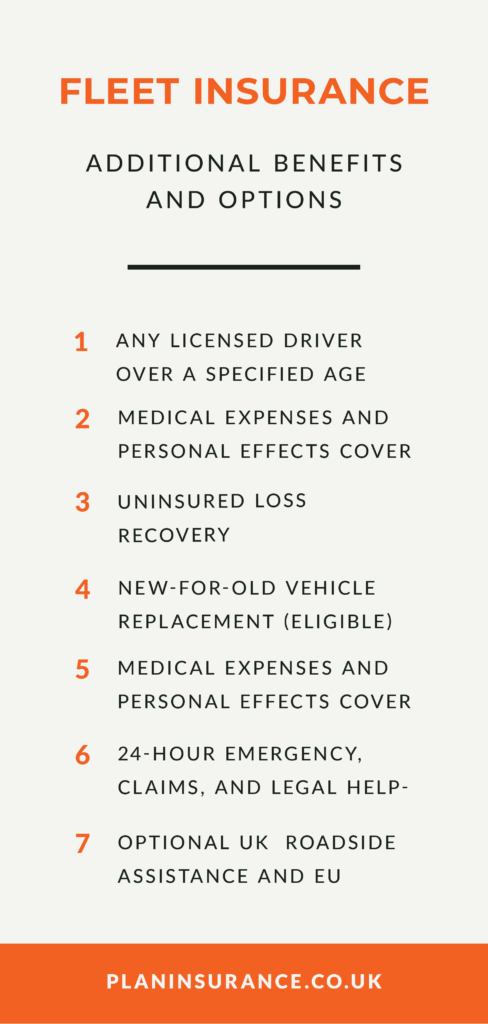
A typical motor fleet policy can include the following:
- Any licenced driver aged over 25 on all vehicles (subject to insurer approval)
- Any licenced driver aged over 17 (subject to insurer approval)
- Flexible monthly instalment plans are available
- Uninsured loss recovery
- New-for-Old vehicle replacement for cars under a year old and goods vehicles under six months old (depending on insurer)
- Medical expenses and personal effects cover’s built in
- 24-hour emergency, claims and legal helpline
- Optional 24 hour UK mainland roadside assistance
- Optional European cover
Having all your vehicles under one policy means one renewal date and one set of policy documents, which can save you both time and money.
A fleet insurance policy can cover you for a variety of different uses including:
- Contractors Fleets
- Mixed vehicle type fleets (including cars, vans and commercial vehicles)
- Couriers
- Hire and Reward
- Private Hire
- Haulage
- Social, Domestic and Pleasure
- Third party or Comprehensive
Vehicles covered on my fleet policy
At plan, we will provide cover for a wide range of vehicles including:
- Cars
- Vans
- Tippers
- Flatbeds
- Curtain-side Trucks
- Tail Lift Trucks
- Articulated Lorries
- Busses
- Coaches
- Agricultural Vehicles
- Special Types such as Forklifts
Having the right insurance in place with correct up to date document templates and guides can help you minimise the risk and liabilities that can take a huge hit on your companies’ profits.
We can provide our fleet insurance clients with extensive risk assessment and management assistance. These include bespoke health and safety documents, task based risk assessments, method statements and much more that will be specific to your business’s activities . These additional documents can be requested when you take out a policy with Plan.
Templates that are available also include business continuity templates that may be updated annually. These will serve as guidance and develop in step with your business operations. Your company will also receive regular notifications regarding legislation changes that are relevant to your fleet and overall business.
You should be able to use your no claims bonus to move from individual policies onto a Fleet insurance policy (providing the no claims bonus is in the name of the Director or Company).
Calculating the cost of a fleet insurance policy is more complex as it is dependent on various factors such as the area you’re based in, your business activity, the type of vehicles you operate and how well your policy has performed over a number of years in terms of claim costs for the insurer.
You will not receive any no claims bonus (NCB), however, you will receive a confirmed claims experience (CCE) report for your fleet. A confirmed claims experience report that indicates low claims costs compared to the premiums charged, will help you obtain more competitive premiums for your policy. More detail can be found under our “What is Confirmed Claims Experience on a Fleet Insurance Policy” FAQ.
We would recommend discussing the following options with your commercial insurance account executive:
Useful fleet information:






Independent Service Rating based on 558 verified reviews. Read all reviews
