


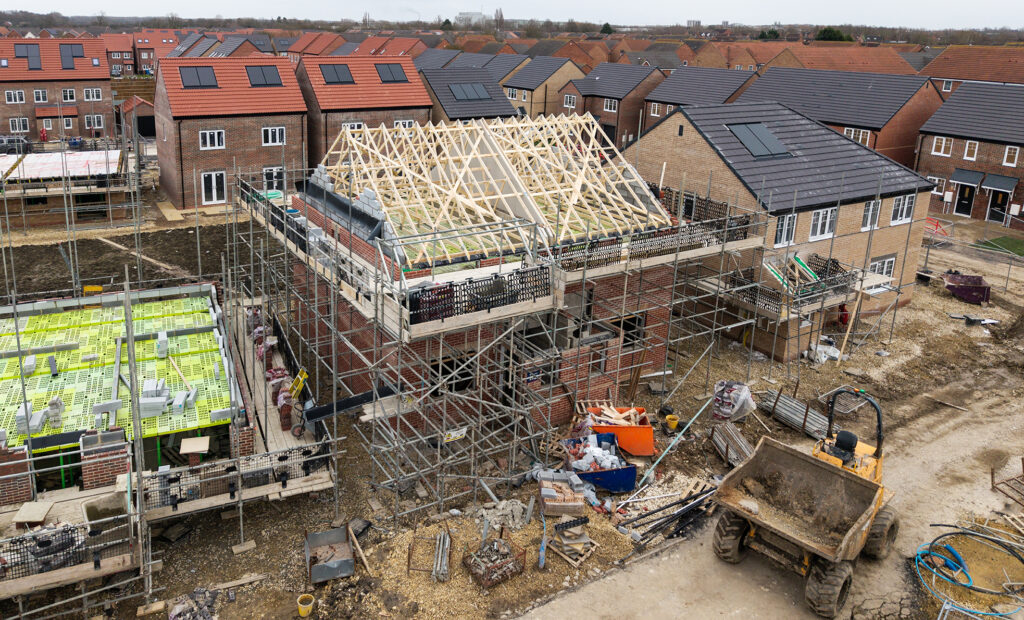

Britain needs more homes. Almost everyone agrees on that. Agreeing on how we actually get them built is rather more difficult, and the UK’s housebuilding crisis has implications for landlords too.
Meeting Britain’s housing needs requires more than demand for homes. It requires people and organisations willing to invest substantial capital and accept the risks involved in providing them. Whatever the source of that investment, there has to be a sufficiently attractive economic case for it to happen.
If the UK cannot build enough homes while demand from both buyers and renters remains strong, the consequences will inevitably be felt across the housing market. And it raises an important question about the future role of private landlords within it.
Why Aren’t We Building Enough Homes?
There isn’t one simple answer. The cost of labour and materials, finance costs, planning delays, land values and uncertainty over buyer demand can all affect whether a development is commercially viable.
This is where the treatment of private landlords becomes relevant to the housebuilding debate itself. Landlords and other investors don’t only buy existing homes; they can also provide early capital for new developments by purchasing properties off-plan. Additional Stamp Duty rates make those investments more expensive and potentially less attractive. That may achieve the policy objective of reducing investor demand, but there is a wider consequence worth considering. If some developments depend on sufficient early sales to become commercially viable, discouraging the very investors prepared to commit capital before the homes exist could ultimately restrict new housing supply.
But another factor is the cumulative effect of regulation
New homes are expected to meet increasingly demanding standards around safety, energy efficiency and environmental impact.
Take Biodiversity Net Gain. In England, developments within its scope are required to deliver a 10% biodiversity gain, measured using a statutory biodiversity metric.
The principle is perfectly understandable. We want more homes, but we don’t want development to come at an unacceptable environmental cost.
The issue is what happens when individual requirements are layered on top of one another.
Each piece of regulation can make sense in isolation. Collectively, however, increased cost, complexity and uncertainty can affect the economics of development. Eventually there comes a point where the numbers simply don’t stack up.
Plan Insurance Brokers can accommodate your Property Owners & Landlord Insurance needs. Just fill in our short call back form, and our professional brokers will be in contact to arrange your insurance.
Helping People Buy Doesn’t Necessarily Create Another Home
Governments understandably look for ways of addressing housing affordability from the demand side. Helping first-time buyers overcome the deposit barrier, improving access to mortgages or providing other forms of financial assistance can all make buying a home easier for an individual household.
But there is a distinction between making a home more affordable to buy and actually creating another home. If demand is stimulated but housing supply cannot respond sufficiently, the underlying shortage remains. Housing policy therefore has to address both sides of the equation.
And this is where the situation becomes particularly relevant to landlords.
Landlords Face a Surprisingly Similar Problem
The private rented sector is subject to many of the same economic forces. Most landlords would accept the need for decent standards, safe homes and appropriate protections for tenants.
The question is what happens when the cumulative burden of taxation, legislation, compliance costs, finance and maintenance begins to materially change the economics of providing those homes.
We have seen significant changes over recent years, and the regulatory landscape continues to evolve. The additional-property Stamp Duty Land Tax surcharge in England and Northern Ireland, for example, increased from 3% to 5% in October 2024. For a landlord buying a £300,000 property under the current rates, total SDLT is £20,000, compared with £5,000 for a non-first-time buyer purchasing the same property as their only home.
That is before considering financing, maintenance, compliance, taxation and the normal commercial risks involved in owning a rental property. The parallel with housebuilding is worth considering.
The problem isn’t necessarily any individual measure. It is what happens when reasonable requirements and additional costs are repeatedly layered on top of one another.
For developers, eventually a site may no longer be viable. For landlords, eventually another property investment may no longer be attractive enough to justify the capital or risk.
But Demand for Housing Doesn’t Simply Disappear
This is perhaps where housing policy becomes contradictory. If Britain builds fewer homes than it needs, the people who would otherwise have occupied those homes don’t disappear.
Some will live with parents for longer. Some will access social housing. Some will eventually buy. Many will continue to rent privately.
The scale of the private rented sector demonstrates its importance. In 2024-25, 4.7 million households in England lived in privately rented accommodation, representing 19% of all households. The proportion has remained broadly around 19% to 20% since 2013-14.
That makes the private rented sector a substantial part of Britain’s housing infrastructure. And it leads to an interesting question.
Can we make it progressively less attractive to be a landlord while simultaneously needing the homes landlords provide?
This isn’t a plea to remove regulation. Nor should landlords expect immunity from taxation or the responsibility to provide good-quality accommodation.
But policymakers do need to consider the cumulative effect of their decisions.
There is an understandable political temptation to see homeowners, first-time buyers, tenants, developers and landlords as separate groups with competing interests.
In reality, they are all participants in the same housing ecosystem.
If it becomes uneconomic to build homes, developers will build fewer of them. If the financial return from providing rental accommodation becomes insufficient for the capital and risk involved, some landlords will choose to invest their money elsewhere. Neither outcome seems particularly helpful if the underlying objective is to increase the availability and affordability of housing.
It therefore seems reasonable to ask whether further landlord-specific taxes, charges or regulatory costs would ultimately help solve Britain’s housing problem, particularly if new housing supply remains constrained.
What Does This Mean for Existing Landlords?
There is another side to this debate. Constrained housing supply does not necessarily make owning rental property unattractive. Quite the opposite could be true for well-run, appropriately financed portfolios in areas where there remains strong demand for good-quality rental accommodation. But it does reinforce the need to treat property investment as a business.
The relevant number is no longer simply the monthly rent or the increase in a property’s value. Landlords increasingly need to understand the real return once they have accounted for:
- mortgage and refinancing costs;
- taxation;
- maintenance and repairs;
- regulatory compliance;
- improvement and energy-efficiency expenditure;
- management costs;
- potential periods without rental income; and
- the capital tied up in the property.
That may lead some landlords to sell. Others may decide to concentrate their investment into fewer, better-performing properties. And some may conclude that constrained supply and resilient rental demand continue to make residential property an attractive long-term investment. There isn’t one answer that applies to every landlord or every property.
A Housing System Has to Work Economically
Perhaps the broader lesson from the current housebuilding difficulties is that good intentions alone don’t create homes. Housing standards matter. Tenant protection matters. Environmental protection matters. So does affordability.
But economic viability matters too. A housing system ultimately needs somebody prepared to commit the capital and accept the risk required to provide the homes, whether that is a housebuilder, housing association, local authority or private landlord.
As costs and regulation change, landlords should therefore continue to reassess their own portfolios. That includes financing and investment returns, but also whether their insurance continues to reflect the properties they own, how they are occupied and any changes being made to them.
The UK doesn’t just need more homeowners. It needs more homes. Achieving that means creating an environment in which building, owning and renting property can all remain commercially viable.